
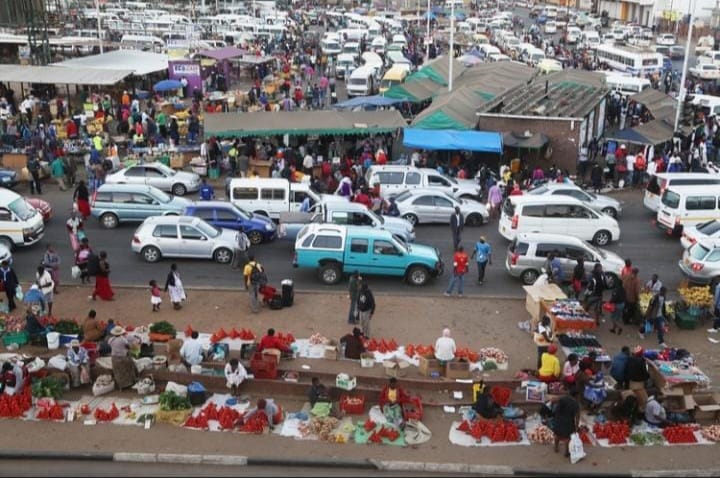
HARARE – The government’s clean-up operation against illegal street vendors in Harare has now moved from directive to deployment. On 9 September , the same day Local Government Minister Daniel Garwe’s seven-day eviction deadline expired, Harare City Council initiated the first phase of its “Chenesa Harare” campaign, deploying at least 300 municipal police officers starting at the E.D. Mnangagwa Road and Samora Machel Avenue intersection, with numbers expected to grow as the operation spreads to other densely populated parts of the city.

At least 300 municipal police officers deployed by the Harare City Council under the “Chenesa Harare” campaign.
The timing remains difficult to separate from the calendar? The amplified crackdown lands roughly six weeks before Zimbabwe hosts the 25th COMESA Summit on 22 October and assumes the bloc’s chairmanship for 2026–2027, running under the theme “One Market, One Future: Advancing Inclusive Industrialization, Investment and Regional Integration in COMESA.”
This will be a period were Harare will be put under sustained regional and diplomatic scrutiny. The “norm” has often always been that governments preparing to host major summits accelerate urban clean ups in the run-up to such events, a well documented pattern. This is precisely because a host city’s optics shape how visiting delegations and investors perceive the country.
Mayor Jacob Mafume has framed the operation in purely functional terms, saying the city needs to reclaim pavements and roads so that traffic, pedestrians and businesses can move freely. He pointed to Mbare Market as evidence that the city has invested in proper trading infrastructure, albeit as some vendors complain that designated sites are poorly maintained or too far from customer traffic.
Notably, Mafume has also said council would investigate how proceeds from a previous vendor registration drive, in which more than 100,000 traders each paid US$10, were used since many vendors said that exercise wasn’t followed by the promised designated spaces.

When the streets become a warzone: Harare vendors face off with council police. (c) southertonbusinesstimes.com
Vendors, for their part, have vowed defiance. Groups on the ground insist the streets are their only means of survival given Zimbabwe’s scarce formal employment and some have dismissed the ultimatum as out of touch with economic realities.
The scale of what’s being contested is significant: Zimbabwe National Statistics Agency (ZIMSTAT) estimates 1.36 million people are in informal non-agricultural employment (41.3% of total employment), with more than 30,000 traders believed to operate in Harare’s CBD alone a population further swollen by Zimbabweans who returned home after the recent xenophobic attacks in South Africa and will likely turn to vending for income.
This is the crux of the credibility question that yours truly has opted to lead with…. yes it’s evident that a genuine, long-standing retailer grievance about untaxed competition is real, look at the collapse of formal players like OK, Food World and many others but the rushed timeline, deadline, deployment and enforcement all compressed into the weeks before COMESA delegates arrive, still points to the summit as the accelerant.
Whether this becomes durable urban policy or a temporary sweep that unwinds once the last COMESA delegate leaves Harare or when the chairmanship tenure ends, will depend on what replaces the vendors once they’re gone. Will it be functional, accessible designated markets or empty pavements…?